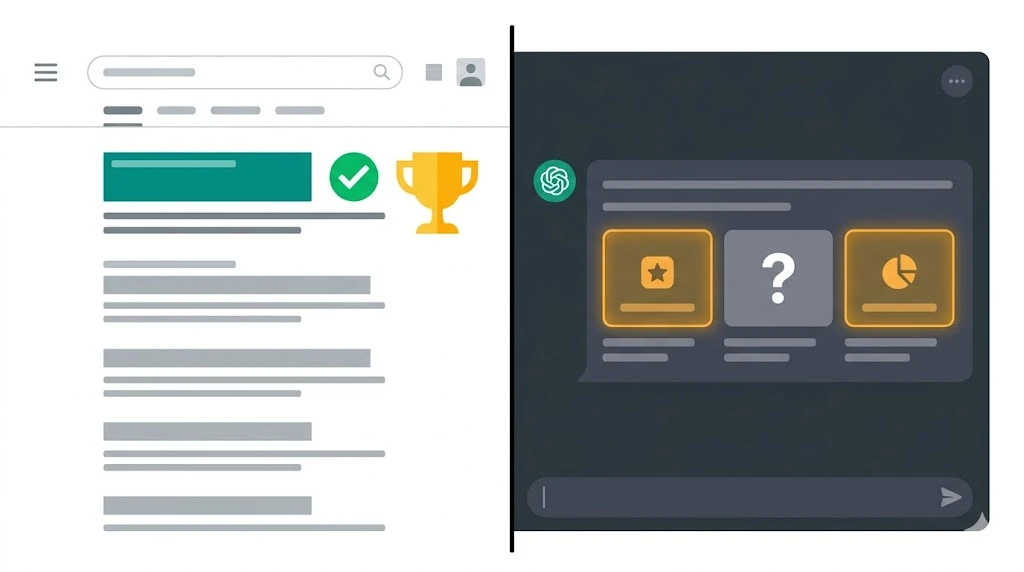
Why your Google rankings don't predict AI citations
You just hit page one on Google for your target keyword.
ChatGPT has never heard of you.
That is not an edge case. It is not a bug. It is the new baseline reality of search in 2026 - and most SaaS founders are not ready for it.
Here is the number that changes everything:
80% of ChatGPT's cited pages don't rank in Google's top 100. Not the top 10. The top 100. The entire first ten pages of Google results. Most of the pages ChatGPT cites don't appear there at all.
If you built your marketing strategy around Google rankings - and spent the last year grinding keyword research, building backlinks, and optimising your content for search - you optimised for one visibility surface while a completely separate one was deciding whether your buyers ever heard of you. That is why competitive intelligence for SEO now has to include AI citation visibility, not just Google positions.
This post breaks down exactly why the two systems are almost entirely disconnected, what each one actually rewards, and what to do if you want both.
The data most SEO guides won't show you
The evidence is not ambiguous anymore.
90% of pages cited by AI tools rank at position 21 or lower in Google search results. 75% of AI citations pull from non-Google sources entirely. The share of AI citations drawn from top-10 Google results has fallen from 76% in mid-2025 to somewhere between 17% and 38% in early 2026, depending on which study you read.
And the stat that lands hardest for SaaS teams specifically: 44% of SaaS brands that rank in Google's top 10 are completely invisible to ChatGPT. Not struggling. Not underperforming. Invisible. ChatGPT has no model of them existing as a credible source.
The gap has a name. It is called the citation gap - the delta between where your brand ranks in traditional Google search and how often it gets cited by AI engines. A brand can hold position one on Google for its most important keyword while being absent from every ChatGPT, Perplexity, and Gemini answer in its category.
What makes this commercially significant is not just visibility. AI search converts at 14.2% versus Google organic's 2.8% - a fivefold conversion advantage per visitor. The buyers who find you through an AI citation are further along, more decided, and more likely to close. Missing from AI search does not just cost you impressions. It costs you the highest-quality traffic in your funnel.
Why Google and AI search are almost completely separate systems
The intuition most founders operate on: if I rank well on Google, AI systems will find my content and cite it.
The reality: only 11% of domains are cited by both ChatGPT and Perplexity. Only 2% of cited URLs appear across AI Overviews, ChatGPT, and Perplexity simultaneously. The three systems are seeing almost entirely different slices of the web.
The reason is architectural.
Google ranks pages. Its algorithm evaluates backlink authority, keyword relevance, technical signals, and user behaviour to decide which page best matches a search query. The output is a ranked list of links.
AI engines don't rank pages. They build trust models of brands.
ChatGPT evaluates your content through four lenses: brand entity strength, topical authority, third-party citation co-occurrence, and technical crawlability. None of those map cleanly to Google's ranking factors.
The clearest way to see this: Google rewards content that matches search intent. ChatGPT rewards brands it trusts. A brand can win on Google by building pages that precisely match specific queries. Winning AI citation requires something harder to manufacture - a web-wide reputation where multiple independent sources agree on who you are and what you do.
If you want the deeper framework, start with how GEO differs from traditional SEO.
How each platform actually decides who to cite
They are not using the same logic. They are not even using similar logic (see the full AI citation rate benchmark by platform — the 2026 data showing a 46x difference between Perplexity at 13.05% and ChatGPT at 0.59% for the exact rates).
ChatGPT operates as a consensus engine. It does not retrieve pages in real time for most responses. It cites from training data and selective web retrieval, weighting sources where multiple independent platforms agree on the same positioning. Wikipedia accounts for 26% to 48% of ChatGPT's top citation share - not because Wikipedia has better content, but because it is referenced everywhere else. Domains with millions of brand mentions on Quora and Reddit have roughly 4x higher chances of being cited than those with minimal activity. If your brand is only discussed on your own website, ChatGPT has weak consensus signal and low confidence in citing you.
Perplexity runs Retrieval-Augmented Generation - it performs a real-time web search for every query. This makes it fundamentally different from ChatGPT. Perplexity averages 21.9 citations per response, more than double ChatGPT's 10.4. Its citation pattern heavily weighted Reddit at 46.7% of top-10 citations until October 2025, when Reddit sued Perplexity over scraping and Reddit citations dropped 86%. YouTube has partially filled that gap and now sits at roughly 16.1% of Perplexity's top-10 citation share. Perplexity rewards content freshness, factual density, and Q&A format structure. Pages updated within the last three months average 6 AI citations versus 3.6 for outdated pages.
Google AI Overviews sits closest to traditional SEO because it is built on Google's index. 93.67% of Google AI Overview citations come from the top 10 organic results - making traditional SEO a prerequisite for Google-based AI citation. But even here the correlation is weakening: the share of AI Overview citations from top-10 organic results dropped from 76% in mid-2025 to 38% in early 2026. YouTube has become the single strongest correlating factor with AI Overview visibility, with brand mentions in YouTube video titles and transcripts outperforming most other signals studied.
Claude draws from Anthropic's training data and, in Claude.ai's web search mode, from live web retrieval. Like ChatGPT, it weights entity authority and consensus signals over raw keyword matching. It has a stronger preference for long-form, expert-written content than Perplexity does.
What signals move AI citations that Google ignores
Understanding the gap is not enough. Here is the specific list of signals that drive AI citation and have almost no relationship to your Google rankings.
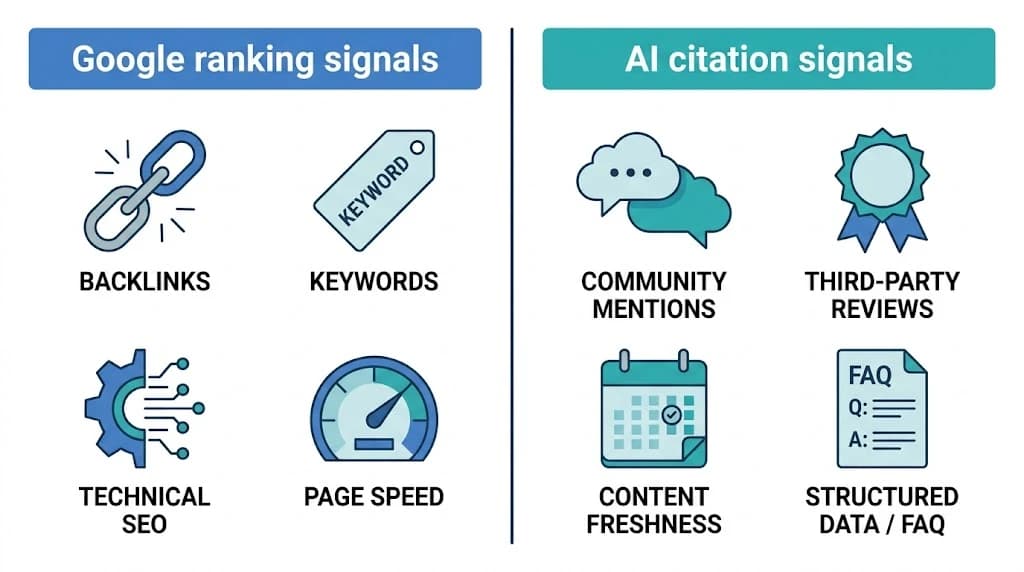
Training data presence. Sometimes AI engines cite a URL purely because it is already known from training data, no live search required. Older, established sites get cited even when their pages are not currently ranking because they are in the training corpus. Consistent, long-term publishing compounds this advantage over time. This is a structural disadvantage for new SaaS products - and the reason building it early matters more than building it well later.
Unlinked brand mentions. Google's algorithm primarily tracks hyperlinks. AI models track mentions - whether or not a link is attached. Getting talked about in the right communities matters even without a backlink. PR coverage, podcast appearances, and industry writeups all feed the model's understanding of who you are. If those third-party mentions say the same things about your brand consistently, the model's confidence in citing you increases.
Third-party platform presence. Domains with profiles on Trustpilot, G2, Capterra, Sitejabber, and Yelp have 3x higher chances of being cited by ChatGPT than those without. Not because those platforms have better content - because they provide independent verification. The AI is looking for consensus across sources it has no reason to distrust. Your own website claiming you are the best tool in the category carries almost no weight. Three G2 reviews saying the same thing carries significantly more.
Community discussion. Forum posts and community discussions frequently out-cite official brand websites in AI answers - specifically because the AI is not impressed by domain authority. It is looking for consensus among independent voices. If your brand is not being discussed authentically in Reddit threads, LinkedIn comments, and niche community forums, AI systems have thin evidence that real people have found you credible.
Content structure for extraction. 44.2% of all LLM citations come from the first 30% of a page's text. 31.1% from the middle section. Only 24.7% from the final third. If your most citable claim is buried in paragraph eight, AI systems will miss it. Answer-first paragraph structure, FAQ blocks, and 120 to 180 word sections between headings all correlate with higher AI citation rates. Pages with FAQ sections and Key Takeaways blocks are cited at meaningfully higher rates than pages without them.
Content freshness. Perplexity has a stronger recency bias than ChatGPT. In fast-moving sectors, newer pages routinely displaced older, higher-authority incumbents in citation position. For "Top AI coding tools in 2026," smaller AI-focused blogs outranked legacy tech publishers simply because their articles were updated within the last few weeks. A content refresh cadence is a citation maintenance system, not just an SEO housekeeping task.
Earned media distribution. Distributing content to a range of publications can increase AI citations by up to 325% compared to only publishing the content on your own site. This is the strongest single lever available - and the one most SaaS content teams are not pulling. Brands are 6.5x more likely to be cited via earned third-party media than their own domains.
What signals move Google rankings that AI ignores
The other side of the gap matters too.
Backlink authority - the primary currency of Google rankings - has almost no direct relationship to AI citation. Sites with over 32,000 referring domains are 3.5x more likely to be cited by ChatGPT than those with up to 200, but that correlation is driven by the brand size and community presence that produces both the backlinks and the citations. Backlinks themselves do not cause AI citations.
Keyword density and on-page optimisation drive Google rankings. AI systems actively discount content that reads like it was optimised for search engines rather than written for readers. The AI is evaluating semantic richness, factual accuracy, and expert depth - not keyword frequency.
Technical SEO factors like Core Web Vitals, page speed, and site architecture affect Google crawl efficiency and ranking. They matter for AI crawlability in a basic sense - a site that blocks AI crawlers or has serious rendering issues will not be cited. Beyond basic crawlability and making your site readable for AI crawlers, technical SEO signals have negligible impact on citation share.
Page authority and domain rating correlate with Google rankings. ChatGPT cites pages from low-authority domains regularly when those pages have strong community corroboration, fresh content, and expert structure. The AI is not running a domain authority check. It is asking whether the content looks trustworthy independent of where it sits.
The practical matrix: what to prioritise based on your goal
This is not an argument that Google SEO does not matter. Traditional organic search still sends 345 times more traffic than ChatGPT, Gemini, and Perplexity combined. The argument is that they require different strategies and you cannot assume one produces the other.
Here is how to think about prioritisation:
If your primary goal is Google traffic volume: Traditional SEO is your main lever. Keyword research, topical authority building, backlink acquisition, and technical site health. This compounds over 6 to 12 months and produces the highest raw traffic numbers. Structured content and FAQ schema help AI citation as a secondary benefit.
If your primary goal is AI citation and B2B buyer trust: Community presence, third-party platform profiles, earned media distribution, and content freshness are your main levers. A single well-placed mention in a Reddit thread your buyers read is worth more for ChatGPT citation than 10 backlinks from obscure directories.
If you want both: Build the content strategy for Google first - topical authority, structured writing, consistent publishing. Then layer in distribution: G2 profile, Trustpilot presence, authentic Reddit participation, earned media placements, YouTube presence, and generative engine optimization. The content does the work on Google. The distribution builds the consensus signals AI needs.
The founders getting this right are not running two separate strategies. They are publishing content that is structured for both - answer-first paragraphs, FAQ schema, factual density, fresh examples - then distributing it across the platforms AI systems trust most.
The measurement problem nobody talks about
Here is what makes this practically difficult: your current analytics cannot see the AI side.
Google Search Console shows you every Google impression, click, and position change. It shows you nothing about whether Perplexity cited you yesterday, whether ChatGPT recommended a competitor in a conversation your ideal customer had this morning, or whether your brand appeared in a Gemini answer that drove someone to your competitor's signup page instead of yours.
The citation gap is invisible in standard analytics. You are flying half-blind, and understanding which tools actually monitor both surfaces is the first step to solving it.
Tracking AI citations manually - querying your brand and category keywords across ChatGPT, Perplexity, Gemini, and Claude, documenting what comes back, repeating monthly - gives you a baseline. It takes roughly 4 to 6 hours per month for 15 queries across 4 platforms. That is the starting point before you have dedicated tooling.
Thoth's AI visibility tracking monitors your citation share across ChatGPT, Perplexity, Gemini, and Google AI Overviews continuously - and connects that data to the content workflow that closes the gaps. When a competitor gains citation share for a query you should be winning, the system flags it and surfaces the content gap driving it. You see both surfaces in one place rather than running two completely disconnected measurement systems.
Start with tracking your citation share across both platforms before you optimise for either one. You cannot close a gap you cannot see.
The one thing to do today
Submit your sitemap to Bing Webmaster Tools if you have not already done so. This takes 10 minutes and is the prerequisite for ChatGPT citation eligibility - ChatGPT sources its real-time web content through Bing. Most SaaS teams have never done this. It is the fastest structural fix for improving ChatGPT visibility and it does not require writing a single word of new content.
Then run your top 5 category queries in ChatGPT, Perplexity, and Gemini today. Write down what comes back. Which competitors appear. Which pages they cite. That is your citation gap, made visible for the first time. That is your content and distribution brief for the next 90 days.
Free AI visibility audit at distribution.studio. Paste your URL. See your citation gap across every major AI platform in 10 minutes - without running the manual queries yourself.