How to build a competitor intelligence system that actually executes
Here is what most SaaS teams call competitor intelligence:
A monthly ritual where someone exports a CSV from Semrush, pastes it into a spreadsheet, highlights 40 keywords in yellow, adds them to a content backlog, and moves on. Three months later the backlog has 200 items, nothing has been published, and the competitor has added 30 more pages in the meantime.
That is not a competitor intelligence system. That is a gap-finding exercise with no execution attached.
The difference between founders whose organic traffic compounds and founders who stay stuck is not the quality of their competitor data. It is whether their competitor intelligence connects directly to content that gets built and published.
This post is the tactical blueprint for building the second kind of system.
Why competitor intelligence fails at the analysis stage
Most teams treat competitor analysis as a one-time project.
Run the gap analysis in January. Build the content plan. Execute through Q1. Repeat in April.
The problem: your competitors are not publishing on a quarterly cadence. They are publishing continuously. The gap you identified in January is smaller in February and closed by March. By the time you have written the content to close it, they have opened five new gaps you have not spotted yet.
That is the first failure mode. There is a second one most teams never see coming.
A competitor could rank below you on every target keyword and still dominate the AI answers your buyers are reading right now. B2B SaaS brands with 30% lower domain authority than their rivals have achieved 4x higher AI citation rates because their content is structured for machine extraction, not just keyword density.
In 2026, your buyers are researching in ChatGPT and Perplexity before they open a browser tab. A competitor intelligence system that only tracks Google rankings is watching half the board and calling it done.
Step 1: Identify your real SEO competitors - not your business competitors
The first mistake most founders make is analysing the wrong companies.
Your business competitors - the ones you pitch against in sales calls, the ones whose pricing page you have memorised - are often not your SEO competitors. The companies ranking for the keywords your buyers search before they even know your product exists are a completely different list.
Find your real SEO competitors by running your 10 most important target keywords through Google and noting which domains appear consistently in the top 10. Not once. Consistently across multiple searches. Those are the domains whose content strategy is directly threatening your organic acquisition.
For most early-stage SaaS teams, the real SEO competitor list has 3 to 5 domains. Not 20. Narrow it before you go deep. Analysing 20 competitors produces a spreadsheet. Analysing 4 produces a strategy.
Step 2: Map three gap types, not one
Most competitor intelligence frameworks only look for keyword gaps - queries competitors rank for that you do not. That is necessary. It is not sufficient.
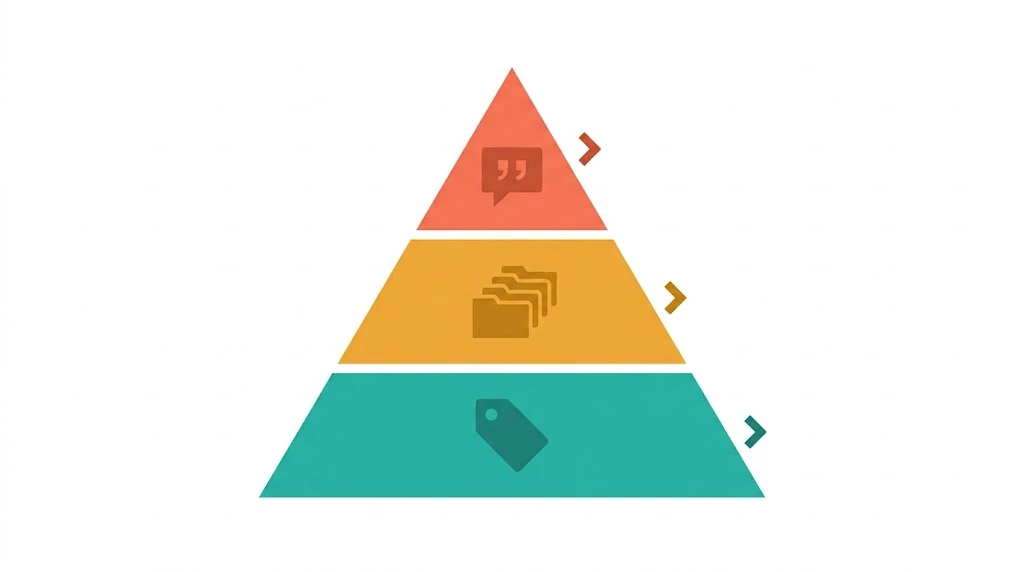
A complete competitor intelligence system maps three distinct gap types.
Keyword gaps are the foundation. These are queries your competitor ranks for that you have no page for. They come with built-in demand validation - the competitor already proved someone is searching for this. If you want the precise keyword gap definition before building the system, start there. Your job is not to decide whether the keyword matters. Your job is to find the exact keywords where you can build something meaningfully better. Prioritise bottom-of-funnel first. A keyword like "AI SEO tool for SaaS startups" converts at a completely different rate than "AI SEO tool" despite the volume difference.
Content depth gaps are where you find your fastest wins. Your competitor has a page for a keyword. You have a page for the same keyword. But their page is 400 words of surface-level coverage and yours could be 1,500 words of tactical depth with original examples and real data. The gap is not always absence. Sometimes it is depth. And AI systems are extraordinarily good at identifying which page actually answers the question and which one just mentions the keyword. The page that answers it gets cited. The one that mentions it does not.
AI citation gaps are the most overlooked gap type in 2026. Running your target queries through ChatGPT, Perplexity, and Gemini to see which competitor gets cited - and which pages they cite - gives you a third gap map that no traditional SEO tool surfaces. Comparing competitor AI citation share vs their Google rankings shows whether they are winning traditional search, AI search, or both. A competitor dominating AI citations for your category is capturing buyer attention before a Google result is ever seen. That is a gap worth closing just as urgently as any keyword gap. In practice, competitor Reddit presence as an intelligence signal and competitor LinkedIn activity as an intelligence signal often give you the earliest warning that this gap is opening.
Step 3: Score gaps before you write a single word
A raw gap list is not a content strategy.
A gap list of 200 unscored items sitting in a spreadsheet is just a different version of the backlog problem. It grows, it intimidates, and it never gets actioned. Score every gap across three dimensions before anything goes into a brief.
Intent value. Is this a keyword a buyer searches before they know your product category exists, while they are evaluating solutions, or when they are ready to decide? Bottom-of-funnel gaps convert fastest. Prioritise solution-aware and decision-stage queries over awareness-stage ones until you have the content volume to support both.
Difficulty vs. your current authority. A DA 25 site cannot realistically close a gap on a keyword where every ranking competitor has DA 70+. Score gaps by whether you can actually win them in the next 90 days. Not whether they would be nice to rank for eventually. Winnable gaps in 90 days compound faster than aspirational gaps that take two years.
AI citation potential. Does this keyword appear as a question in ChatGPT or Perplexity? Is the current top-cited source thin, outdated, or poorly structured? High AI citation potential gaps are where a well-structured, schema-marked page can displace a weaker competitor citation within weeks. Traditional SEO rankings take months to move. AI citation gaps can close in days when your content is structured correctly.
Step 4: Build the brief from the gap - not from scratch
This is where most competitor intelligence processes disconnect from execution.
The gap analysis sits in one tool. The content brief lives in another. A human has to interpret the data, write the brief, and hand it to a writer. By the time the content gets written, the brief is already stale. The gap you briefed in week one might be half-closed by week three because your competitor published something new in the meantime.
The fix is architectural. The gap itself should generate the brief.
A competitor ranks for "how to automate competitor keyword research." Your gap analysis flags it. The brief should emerge directly from that gap: the target keyword is confirmed, the intent is clear (how-to, mid-funnel), the competing page sets the minimum bar for depth and structure, and the AI citation potential tells you whether to lead with FAQ schema and answer-first paragraph structure.
No interpretation step. No handoff delay. No brief that sits in a doc waiting for someone to act on it.
When the gap generates the brief automatically, the time between identifying an opportunity and closing it collapses from weeks to hours.
Step 5: Run the system continuously - not monthly
A monthly competitor intelligence cadence made sense when content production was slow.
At one blog a week, checking for new gaps monthly was fine. You could not publish faster anyway, so gap freshness did not matter much.
The constraint has changed. Content production can now move at whatever cadence your system supports. The bottleneck is intelligence freshness, not writing speed. A continuously running system monitors competitor publishing, flags new keyword entries, tracks AI citation share shifts, and surfaces new gaps in real time.
When a competitor publishes a new page targeting a keyword in your priority cluster, you know within days. Not at the next monthly review. Not after three weeks of sitting on stale data.
That responsiveness is where the compounding advantage comes from. You are not reacting to a competitor's strategy from three months ago. You are closing gaps as fast as they open. Over six months, the difference between monthly and continuous intelligence is not incremental. It is structural.
What this looks like when it actually executes
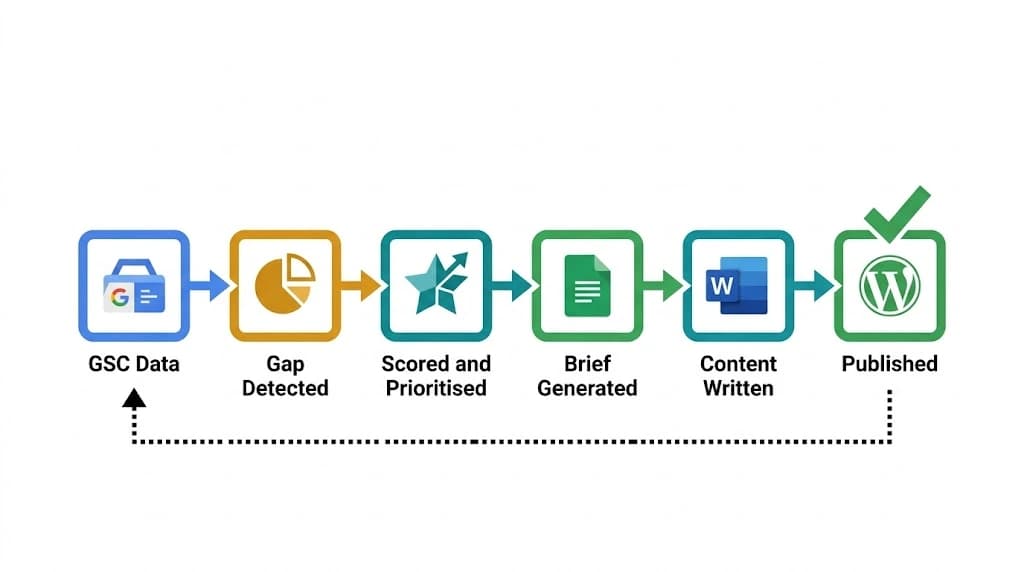
The system described above has six distinct components: competitor identification, three-layer gap mapping, gap scoring, brief generation, content production, and continuous monitoring.
Built manually, this is a full-time role. Even with the best point tools, Semrush for keyword gaps, Ahrefs for backlinks, manual ChatGPT queries for citation gaps, a separate brief template, a writer, and a publisher, the joins between each step require a human at every handoff. Most SEO consultants do the join in their head. Thoth does it in the workflow.
Your GSC data feeds in as the baseline. Competitor domains are mapped against your keyword positions. Three-layer gaps surface automatically: keyword gaps, content depth gaps, and AI citation gaps together in one view. Priority scoring runs against intent value, difficulty, and citation potential. Briefs generate from the gap data. Content is written against the brief, structured for both Google and AI search, and published directly to your Ghost CMS.
The competitor publishes a new page on Monday. Thoth surfaces the gap by Tuesday. The content to close it is live by Thursday.
That is not a content calendar. That is a competitive intelligence system that executes.
Free competitor gap audit at distribution.studio. Paste your URL and see your three-layer gap map in 10 minutes.
FAQ
_Thoth maps your competitor gaps automatically across keyword, content depth, and AI citation layers - then closes them with content written, structured, and published without you touching a tab. Free audit at distribution.studio._
Back to all blogs