
How to Get Cited by AI: SEO, AEO & GEO Explained
Google ranking alone won't cut it in 2026. Here's the difference between SEO, AEO, and GEO - and how to structure your content so ChatGPT, Perplexity, and Gemini cite you by name.
On this page
Table of contents
How to Get Cited by AI: SEO, AEO & GEO Explained
Your competitor just appeared inside a ChatGPT answer to a question your ideal customer asked. You didn't.
You both rank on Google. You both have decent domain authority. The difference isn't keywords - it's that they structured their content for how AI reads, not just how humans search.
That gap is widening every week. And if you're only optimizing for Google in 2026, you're running a race that's already added two new tracks you don't know exist yet.
This post breaks down exactly what SEO, AEO, and GEO are, why each one matters, and - critically - how to structure your content so that AI systems actually cite your brand instead of your competitors. If you're looking for AI search optimization 2026 strategies, this is the foundation.
Why Google ranking alone isn't enough anymore
Here's the uncomfortable number: AI Overviews have reduced click-through rates for top-ranking Google content by 58%. You can rank first on Google and still lose the click because an AI summary answered the question above your result.
Meanwhile, the platforms eating those clicks are growing fast. ChatGPT now serves 800 million weekly active users, Gemini surpasses 750 million monthly, and Perplexity has grown past 45 million monthly active users.
ChatGPT processes 2.5 billion prompts daily, 65% of which qualify as search. People aren't just using it to write emails. They're using it to research tools, compare products, and decide what to buy.
If your brand isn't in the answer those platforms generate, you don't exist in that moment. It doesn't matter that you rank #2 on Google.
That's the problem SEO alone can't solve. That's what AEO and GEO are built for.
What is SEO? (And what it can't do anymore)
SEO (Search Engine Optimization) is the practice of making your content rank on Google and Bing - getting your pages to appear when someone types a query into a traditional search engine.
It's still essential. Traditional organic search still sends 345 times more traffic than ChatGPT, Gemini, and Perplexity combined as of late 2025. Anyone telling you SEO is dead is wrong.
But SEO was built for a world where search meant: user types query -> Google returns 10 links -> user clicks one. That world is shrinking. The new world is: user asks AI a question -> AI synthesizes an answer from multiple sources -> user reads the answer and never clicks anything.
SEO gets you on the field. It doesn't guarantee you're in the play.
What is AEO in SEO? (answer engine optimization)
AEO (Answer Engine Optimization) is the practice of structuring your content so AI-powered systems select it as the direct answer to a question - in Google's AI Overviews, voice search, and featured snippets. If your goal is to rank in Google AI Overviews, AEO is the layer that makes that possible.
AEO optimizes for zero-click search, while GEO optimizes for AI citations. Both work together as part of a comprehensive AI search strategy.
Think of AEO as optimizing for extraction. You're writing content so that an AI system can lift a clean, complete answer directly from your page and serve it to the user - even if they never visit your site.
That sounds like you lose the click. You do. But you win something more valuable: your brand becomes the source of truth in that answer. Users associate expertise with the brand that was cited, not the ten links they scrolled past.
What AEO requires in practice:
- Question-based H2 and H3 headings (exactly how users phrase queries)
- Direct answers in the first 1-2 sentences of each section - no preamble
- FAQPage schema markup (FAQPage JSON-LD) so AI crawlers can identify Q&A pairs
- Short, extractable paragraphs of 40-80 words per answer
- Definitions that AI can quote verbatim
Write every important section as if it could be extracted and read alone - because AI will do exactly that.
What is GEO optimization? (generative engine optimization)
GEO (Generative Engine Optimization) is the practice of structuring your content so large language models - ChatGPT, Perplexity, Gemini, Claude - cite your brand inside their generated responses. This is where LLM citation strategy becomes a direct growth lever.
GEO works by structuring content intentionally to make it AI-friendly, with a focus on authority, clarity, and factual accuracy.
The distinction from AEO: AEO targets AI-powered features inside search engines. GEO targets the AI platforms themselves - the ones users go to directly instead of Google.
Research from Princeton University shows that GEO methods can boost visibility in generative engine responses by up to 40%. That's not a marginal improvement. That's a structural advantage that compounds over time as AI platforms grow.
The catch: only 11% of domains are cited by both ChatGPT and Perplexity - meaning most brands appear in one AI platform at most, or none at all. The opportunity to own this space before it saturates is open right now and closing fast.
How does ChatGPT decide what to cite, and how does Perplexity choose sources?
This is where it gets tactical - and where most guides stop too early.
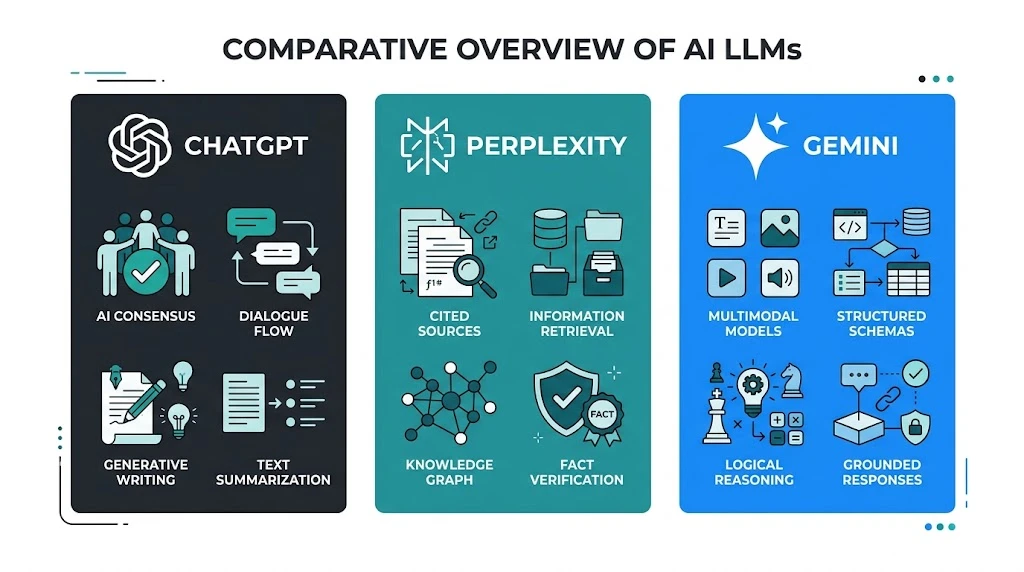
Each AI platform uses different trust signals. ChatGPT favors consensus across authoritative third-party sources. Gemini prioritizes brand-controlled content and schema verification. Perplexity focuses on niche expertise in retrieved documents.
Breaking this down further:
ChatGPT acts as a consensus builder. If Wikipedia, G2, Trustpilot, Reddit, and analyst blogs all align on your positioning, ChatGPT treats it as factual truth. ChatGPT does not reward originality - it rewards agreement. Your strategy here is third-party mentions, consistent brand descriptions across platforms, and showing up in communities your audience trusts.
Perplexity runs on Retrieval-Augmented Generation (RAG). It heavily weights content freshness and sector-specific authority. Its most striking citation pattern: Reddit accounts for 46.7% of its sourced content. Perplexity rewards real expertise - product docs, comparison guides, expert explainers beat corporate marketing copy every time. If you want to rank in Perplexity, depth and freshness beat brand polish.
Gemini is natively integrated into Google's index. Gemini takes a distributed approach across specialist blogs, news outlets, and professional opinion. It rewards brands that Google can verify, not just mention. Schema markup, Google Knowledge Panel, and strong on-page structure matter more here than anywhere else.
Bing/ChatGPT Search has one prerequisite most teams miss: Bing indexing is a non-negotiable requirement for appearing in ChatGPT's cited sources - yet most SEO teams have never submitted a sitemap to Bing Webmaster Tools.
The layer that makes all of it work: machine-readable content
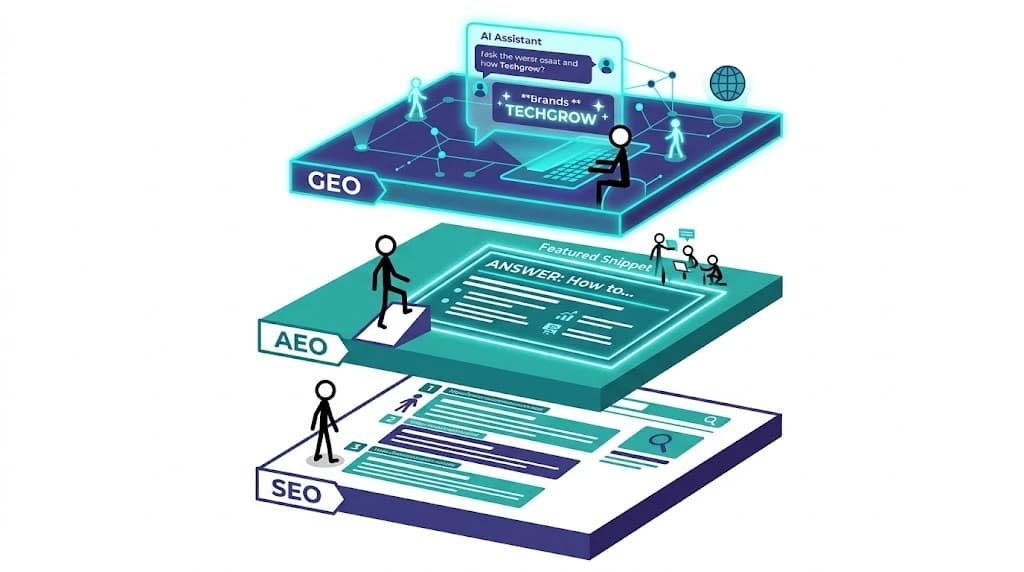
SEO gets you indexed. AEO gets you extracted. GEO gets you cited. But none of it works if your content isn't structured for how AI crawler systems actually read.
AI systems don't read your blog the way a human does - top to bottom, absorbing context. They scan for signals: clear headings, explicit definitions, structured Q&A, schema markup, consistent entity naming, factual claims they can verify. This is the core of content structure for LLMs.
A strong SEO foundation makes your content discoverable. AEO practices make it extractable. GEO strategies make it citable. In 2026, doing one without the others leaves significant visibility on the table.
Machine-readable content means:
1. Structured headers that answer questions directly. Not "The importance of content strategy" - instead "What is content strategy and why does it affect rankings?" H2s and H3s should read like questions users actually type into AI chat interfaces.
2. Answer-first writing. Every section opens with the direct answer, then supports it with context. No 3-sentence build-up before you get to the point. AI crawlers extract the first sentence of a section - if it isn't the answer, you're not getting cited.
3. FAQPage schema. This is the single highest-impact technical change you can make for AI visibility. FAQPage schema in JSON-LD format makes your question-answer pairs directly machine-readable by language models. Each structured Q&A becomes an explicit citation candidate.
4. Consistent entity naming. Every time you mention your brand, product, or core category, use the same exact phrasing. AI models build entity maps - inconsistent naming fragments your authority signal across sources.
5. Original data and citations. Perplexity and ChatGPT both favour content that demonstrates firsthand expertise. Stats, original research, case study numbers - anything that can't be found anywhere else makes your content a primary source worth citing.
The timeline reality: how fast do AI platforms index you?
Results from AEO and GEO for AI search typically appear faster than traditional SEO. You can see your first AI citations within 2-4 weeks of implementing proper schema markup and optimization strategies.
Platform-specific indexation lags matter though. For ChatGPT, expect a 4-8 week indexation lag for newer content before it surfaces in answers. Perplexity indexes faster: 1-2 weeks for fresh content.
The practical implication: start now. Every week you wait, a competitor is building citation authority that compounds. AI citations compound - when ChatGPT cites your content, users start associating your brand with expertise on that topic, and AI models keep returning to sources that performed well before.
How to measure AI share of voice and brand citation in AI search
To make AI visibility optimization concrete, track your AI share of voice by monitoring how often your brand appears for high-intent prompts across ChatGPT, Perplexity, and Gemini versus named competitors.
This is how you measure brand citation in AI search in practice: run a fixed prompt set monthly, record whether you're cited, and track movement by topic cluster. If you're investing in agentic SEO, this measurement layer keeps execution tied to business outcomes.
Where most brands get this completely wrong
They treat SEO, AEO, and GEO as three separate projects requiring three separate workflows. They're not.
The content structure that earns Google rankings also makes content AEO-extractable. The authority signals that drive GEO citations reinforce your Google domain authority. GEO doesn't replace SEO - it layers on top of it.
The problem is execution. Manually restructuring every piece of content for AI readability - adding schema, writing answer-first intros, maintaining entity consistency, monitoring AI citations across ChatGPT, Perplexity, and Gemini - is a full-time job layered on top of the SEO work you're already doing.
The practical starting point
If you're doing this yourself, start here:
Submit your sitemap to Bing Webmaster Tools today - it's a 10-minute task most teams skip that unlocks ChatGPT citation eligibility.
Add FAQPage schema to your top 10 performing pages this week. Each Q&A pair becomes an explicit AI citation candidate.
Rewrite your H2s as direct questions. "Why traditional SEO is failing in 2026" becomes "Why is traditional SEO failing in 2026?" - one word change, meaningfully different for AI extraction and how to appear in AI Overviews.
Run your brand name as a query in ChatGPT, Perplexity, and Gemini. Document what comes back. That's your baseline. Repeat monthly.
The brands that own AI search in 2027 are setting this up now. Not next quarter.
FAQ
What is the difference between SEO AEO and GEO?
SEO optimizes content for traditional search engines like Google. AEO (Answer Engine Optimization) structures content to be extracted as direct answers in AI-powered features like Google's AI Overviews and voice search. GEO (Generative Engine Optimization) optimizes content to be cited by AI platforms like ChatGPT, Perplexity, and Gemini inside their generated responses.
Does GEO replace SEO?
No. GEO builds on top of SEO. Traditional search still drives far more traffic volume than AI platforms combined. The most effective strategy in 2026 combines SEO for organic traffic with AEO and GEO for AI visibility and brand citation.
How long does it take to rank in AI-generated answers?
AI citations can appear faster than traditional SEO rankings. Most brands see initial AEO results within 2-4 weeks of implementing schema markup. ChatGPT has a 4-8 week indexation lag for new content; Perplexity indexes in 1-2 weeks.
How to rank in ChatGPT and get cited by AI?
Focus on consensus signals across trusted third-party sources, structured answer-first content on your own site, and consistent entity naming everywhere your brand appears. If your goal is how to get cited by AI, combine SEO foundation, AEO extraction format, and GEO authority signals instead of relying on one tactic alone.
What content structure works best for AI citation?
Answer-first paragraph structure, question-based H2/H3 headings, FAQPage schema markup, consistent entity naming, and original data or statistics. AI crawlers extract and cite content that is easy to parse and verify - not content that requires reading context to understand.
Want your content automatically structured for AI search - schema, answer-first writing, entity consistency built in from day one? That's exactly what an AI SEO system handles. See how ->