
What is AI Citation Tracking and Why It Matters Now
Your brand is being recommended or ignored inside ChatGPT right now. You have no idea which one. Here is what AI citation tracking is, how to do it, and what it tells you that Google Search Console never will.
On this page
Table of contents
What is AI citation tracking and why your SaaS brand needs it in 2026
Your brand is being recommended or ignored inside ChatGPT answers right now.
You have no idea which one.
That is not a gap in your analytics. It is a gap in your entire visibility model. Google Search Console tells you which queries sent people to your site. It tells you nothing about what happened before the click - the AI-generated answer your prospect read, the three brands that got cited in it, and whether yours was one of them.
AI Overviews now appear in 48% of all Google searches, up from 34.5% in December 2025. ChatGPT has reached 883 million monthly users. Gemini grew from 5% to 21% market share year over year.
These are not future numbers. This is where your buyers are researching right now. And the brands that show up in those AI-generated answers are capturing attention, trust, and buying intent before a single Google result is ever clicked.
AI citation tracking is how you find out whether you are one of those brands - or whether you are invisible while your competitor gets recommended in every answer that matters.
What is AI citation tracking?
AI citation tracking is the practice of systematically monitoring how often, where, and in what context AI platforms - ChatGPT, Perplexity, Gemini, Claude, Google AI Overviews - cite, mention, or recommend your brand in their generated responses.
Citations and mentions are different things and both need to be tracked. Citations link directly to your content. Mentions reference your brand without a link. Both signal AI visibility. Neither shows up in your existing rank tracker.
The simplest way to understand it: traditional rank tracking tells you where your pages appear in a list of ten blue links. AI citation tracking tells you whether your brand appears in the answer that replaced those ten links.
AI citation tracking is the new rank tracking. Traditional rank trackers are blind to LLM mentions - and tools like Semrush One, Profound, Evertune, and OpenForge fill that gap by monitoring how ChatGPT, Perplexity, Gemini, and Claude reference your brand.
Why Google Search Console cannot tell you this
Most SaaS founders live in GSC. Impressions, clicks, average position, CTR. It is the closest thing to a ground truth most teams have for organic performance.
Here is what GSC cannot see:
A founder opens ChatGPT and types "what is the best AI SEO tool for an early-stage SaaS startup." ChatGPT generates an answer. It cites three tools. Yours is not one of them. The founder reads the answer, picks one of the three cited tools, and goes directly to that site. No Google search. No impression. No click. No trace in your GSC data.
That interaction happened. Your competitor won it. You will never know.
93% of AI Mode sessions end without a click, meaning brand visibility inside AI responses is often the only impression you get. If that impression does not include your brand, the session is over before you ever entered the picture.
GSC measures what happens after someone chooses to visit your site. AI citation tracking measures what happens in the moment they decide where to go.
What AI citation tracking actually measures
Once you understand what to look for, the measurement framework has four layers:
Brand mention frequency. How often does your brand appear across a set of target queries? A 25% share of voice means your brand appears in one out of four relevant AI responses - though benchmarks vary significantly by industry size and competition level. That share of voice number is your baseline. Every week it goes up or down tells you whether your content strategy is working.
Citation position. Being mentioned is not enough. Position matters significantly. Brands mentioned first carry more weight than those appearing later in an AI-generated response. Tracking position tells you whether you are the primary recommendation or an afterthought at the end of a list.
Page-level citation source. Which specific pages on your site are being cited - and which are being ignored? Most tools tell you your brand appeared in an AI response. The more precise insight is which specific page the AI pulled from, how often that page is cited across different prompts, and where it sits in the citation order. Knowing this tells you exactly which content to create more of and which existing pages to restructure for AI readability.
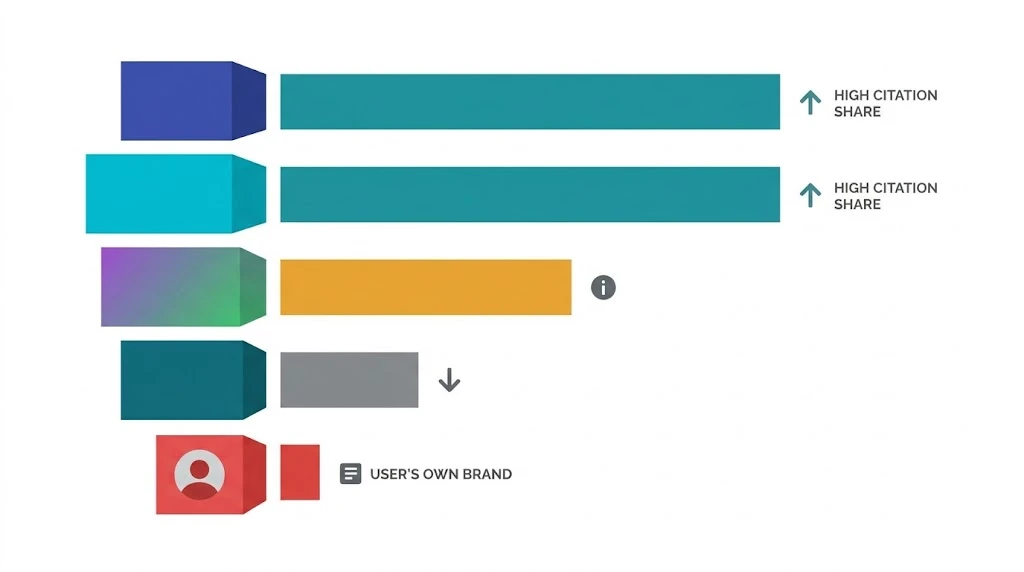
Competitor citation share. The most actionable number in AI citation tracking is not your own citation rate - it is the gap between yours and your closest competitor's. If they appear in 6 out of 10 relevant ChatGPT answers and you appear in 2, you have a quantified gap with a clear content brief to close it.
How each AI platform cites differently
This is the part most guides skip, and it is the part that changes everything about how you create content.
Perplexity provides citations for nearly every claim it makes - it has the highest citation density of any major AI engine. Gemini demonstrates a strong preference for brand-owned content, with roughly 52% of its citations originating from brand-owned websites. ChatGPT operates on consensus logic, with nearly 49% of its citations coming from third-party directories and aggregators.
What this means in practice:
For Perplexity, you need factually dense content with clear, verifiable claims. Product documentation, comparison guides, and expert explainers outperform marketing copy every time.
For Gemini, your own website is the primary battleground. Strong schema markup, structured content, and a verified Google Knowledge Panel matter more here than on any other platform.
For ChatGPT, third-party mentions are the currency. Reddit is the number one source across every major AI engine, cited at roughly 40% frequency across LLMs. Wikipedia accounts for 26% to 48% of ChatGPT's top citation share. Being mentioned authentically in communities your audience trusts - Reddit, G2, niche directories, founder forums - feeds directly into ChatGPT's consensus model.
An AI can start hallucinating incorrect information about your brand - claiming a product has been discontinued, misquoting your pricing, or confusing you with a similarly named company. Continuous monitoring catches these shifts in real time. This alone is a reason to track AI citations regardless of where your citation share currently stands.
How to track AI citations manually
Here is the honest version before the automated version.
Manual AI citation tracking works. It is just slow, inconsistent, and impossible to scale past about 20 queries.
Step 1. Build a list of 10-15 queries your buyers actually ask AI platforms. Not your brand name - the category questions. "Best AI SEO tool for SaaS," "how to automate content marketing," "what replaces an SEO agency for a small team."
Step 2. Run each query across ChatGPT, Perplexity, Gemini, and Claude. Document the full response in a spreadsheet. Note whether your brand is cited, where it appears, and which competitor is cited most frequently.
Step 3. Repeat monthly. Note what changed. Which competitor gained share. Which of your pages got cited for the first time. Which query stopped returning your brand entirely.
Step 4. For each query where a competitor is cited and you are not, treat it as a content brief. What does their cited page have that yours does not? Structure, schema, depth, third-party mentions, recency?
This process gives you real signal. It takes about 4-6 hours per month for 15 queries across 4 platforms. That is 60 manual queries, documented, compared, and actioned.
Why manual tracking breaks at scale
The math is straightforward.
You have 50 target keywords. Each needs testing across 4 AI platforms. That is 200 manual queries per month - before you account for the fact that AI assistants prefer fresher content, with cited URLs averaging 25.7% newer than traditional search results. Results shift week to week, not just month to month. A query that cited you last Tuesday may cite a competitor today because they published a better-structured piece 48 hours ago.
At 200 queries a month, done rigorously, you are looking at a full week of work just on monitoring - before you have written a single word of content to close the gaps you found.
The second problem is attribution. Manual tracking tells you your brand appeared in a ChatGPT answer. It does not tell you which page was cited, how that citation influenced the visitor's behaviour when they landed on your site, or whether that visitor converted. Platforms like Profound connect AI mentions to conversion data, showing which AI-referred visitors actually become customers. Without that attribution layer, you are optimising blind.
What a dedicated AI citation tracking tool does
An AI citation tracking tool automates the monitoring layer and adds the attribution layer manual tracking cannot provide.
The core functions: continuous query monitoring across ChatGPT, Perplexity, Gemini, and Claude; brand mention and citation detection with sentiment analysis; competitor citation share comparison; page-level citation source identification; and alerts when your citation share drops or a competitor gains ground.
The attribution layer: connecting AI-generated mentions to site visits, tracking which AI-referred visitors convert, and identifying which cited pages produce the highest-value traffic.
The brands that track AI citations systematically can optimise with precision. Those that do not are invisible when AI recommends competitors instead.
Thoth's AI citation monitoring runs this continuously as part of the same system that audits your SEO, identifies competitor gaps, and publishes the content that closes them. You do not need a separate tool for citation tracking and a separate tool for content execution. The monitoring feeds directly into the content workflow - a gap surfaces, a brief is generated, a page is published. One loop, not three disconnected tools.
From AI visibility to closed revenue
AI citation tracking tells you when your brand is winning visibility inside ChatGPT, Perplexity, and Gemini.
But visibility without a sales system is just vanity.
Once someone finds your brand through an AI-generated answer and lands on your site, the clock starts. Most teams have no system to act on that signal fast enough - the visit happens, no one follows up, the intent evaporates.
That is where SwitchStack closes the loop. SwitchStack is the modular sales platform for outbound teams - power dialer, CRM, AI call coaching, and autonomous lead generation in one system. The Growth Engine runs 24/7, monitoring intent signals and running personalised outbound sequences automatically.
If Thoth is the engine that gets your brand cited, SwitchStack is the team that converts those citations into pipeline. Same ecosystem. One loop from discovery to closed revenue.
FAQ
What is AI citation tracking?
AI citation tracking is the practice of monitoring how often and where AI platforms - ChatGPT, Perplexity, Gemini, Claude, and Google AI Overviews - cite, mention, or recommend your brand in their generated responses. It measures brand visibility in AI-generated answers, which traditional rank trackers and Google Search Console cannot detect.
What is the difference between AI citation gap analysis tools and traditional SEO content gap tools?
Traditional SEO content gap tools compare your keyword rankings against competitor rankings in Google search results. AI citation gap analysis tools compare your brand's appearance in AI-generated answers against competitors' appearance in those same answers. SEO content gaps show you which keywords you are not ranking for. AI citation gaps show you which AI answers you are not appearing in - a fundamentally different and increasingly more important visibility problem.
What are the leading solutions for AI citation tracking today?
The established tools in this category include Profound (enterprise, starts at $499/mo, 10+ AI engines), Otterly.AI (entry-level, starts at $29/mo), SE Visible (integrated with traditional SEO metrics), and Topify (citation-level tracking across ChatGPT, Gemini, Perplexity, Claude, DeepSeek). Thoth includes AI citation monitoring as part of its broader autonomous marketing system, connecting citation tracking directly to content execution and publishing - so gaps get closed, not just documented.
How do I know if my brand is being cited in ChatGPT or Perplexity?
The manual method: run your top 10-15 category queries across ChatGPT, Perplexity, Gemini, and Claude. Document whether your brand appears, where it appears, and which competitors are cited more frequently. Repeat monthly. The automated method: use an AI citation tracking tool that runs continuous monitoring across these platforms and alerts you when your citation share changes.
What is Google AIO citation tracking?
Google AIO (AI Overviews) citation tracking is the specific practice of monitoring when Google's AI-generated summary boxes cite your content as a source. AIO citations appear above traditional search results and capture attention before any blue link is seen. Tracking AIO citations separately from standard rank tracking is important because a page can rank well in traditional results while being absent from AI Overviews, or vice versa.
Why does AI citation position matter, not just mention frequency?
Being mentioned in an AI-generated answer is not binary. A brand mentioned first in a ChatGPT response carries significantly more weight than a brand listed fourth. AI citation tracking tools that measure position - not just presence - give you a more accurate picture of your actual competitive standing in AI search.
Thoth monitors your AI citation share across ChatGPT, Perplexity, Gemini, and Google AI Overviews - and closes the gaps automatically through content that is written, structured, and published without you touching a tab. Free audit at distribution.studio.