
Manual SEO Is Dead. Meet Your AI CMO
Manual SEO gives you data and a to-do list. An AI CMO gives you execution. Here's why the old model is a growth ceiling - and what the new one looks like.
On this page
Table of contents
Manual SEO Is Dead. Meet Your AI CMO
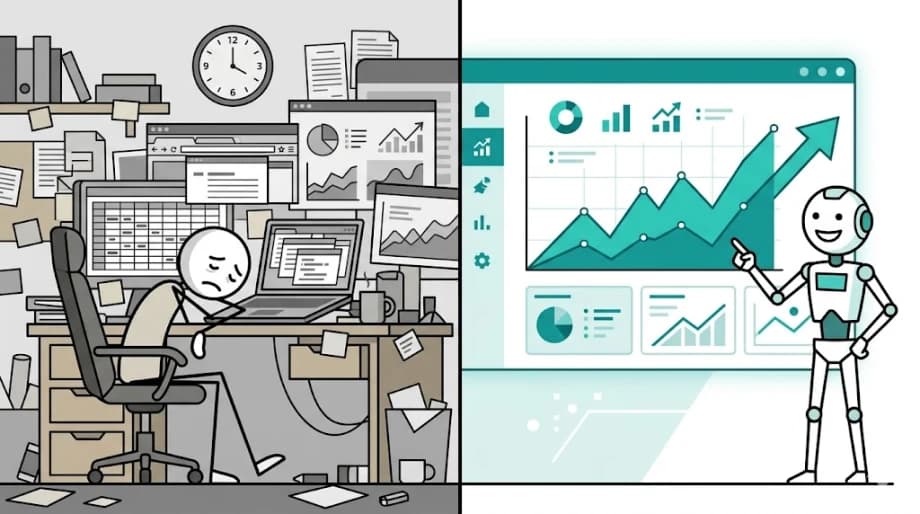
Your startup's SEO strategy isn't failing because you picked the wrong keywords. It's failing because you're treating a systems problem like a task problem.
You run the audit. You find the gaps. You build the content calendar. You write the blogs. You publish them. You check GSC two weeks later, wonder why nothing moved, and then repeat the whole cycle again.
That's not an SEO strategy. That's a second job - one that scales terribly.
In 2026, the founders who are winning organic growth aren't the ones who are better at SEO. They're the ones who stopped doing SEO manually altogether.
The tool trap: manual SEO tasks that cost you 20 hours a week
Here's the uncomfortable truth about most SEO tools: they give you homework, not results.
Semrush tells you your competitors are ranking for 400 keywords you're not. Ahrefs shows you a domain authority gap. Google Search Console surfaces pages with declining impressions. All useful. All accurate. All completely inert until a human - usually you - sits down and does something about it.
That's the tool trap. The data is there. The insight is there. But execution still falls entirely on your shoulders.
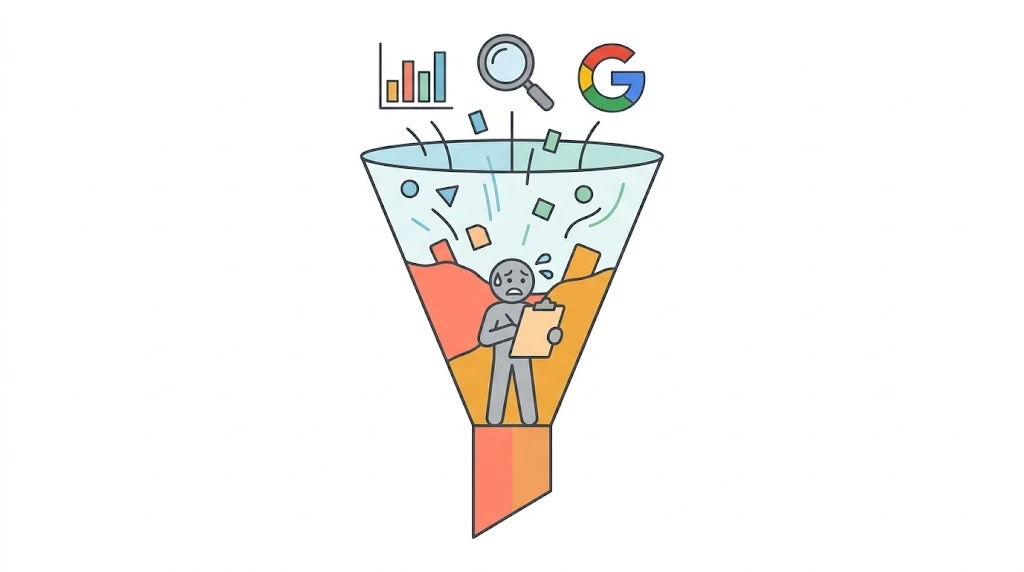
A founder or growth marketer using traditional SEO tools spends roughly 15-20 hours a week on the cycle: audit, plan, write, publish, monitor. If you're wondering how much time does SEO take per week, that's your answer. For a bootstrapped team, that's not a marketing investment. That's a growth ceiling disguised as a workflow.
And the market isn't going to wait while you work through your content backlog.
What is an AI CMO, really?
The phrase gets thrown around loosely, so let's be precise.
An AI CMO isn't a chatbot you ask for blog ideas. It's not a content spinner or a keyword tool with an AI badge slapped on it.
An AI CMO is an automated SEO platform that closes the loop between data and SEO execution - automatically.
It connects to your real SEO data (Google Search Console, competitor rankings, your existing content). It identifies what's missing. It writes the content. It publishes it. And it monitors what happens next. No handoffs. No export-import-format-upload. No weekly "let me check the dashboard" ritual. This is Google Search Console automation tied directly to outcomes.
The distinction that matters: traditional tools tell you what to do. An AI CMO does it.
This is the shift most marketers are still sleeping on in 2026. The category of "AI SEO tools" has exploded, but most of them are still just smarter data dashboards. The frontier has moved to autonomous SEO execution - and the gap between analysis and action is exactly where growth gets lost.
Why manual SEO doesn't scale - and never did
Manual SEO was always a scaling problem. It just wasn't visible when you only had one person and one blog to worry about.
The math breaks down fast. If you want to rank for 50 relevant keywords, you need roughly 50 well-researched, well-optimized pieces of content. At 4-6 hours per piece (research, writing, editing, publishing), that's 200-300 hours of work. At one blog a week, you're 12 months out before your content moat even starts forming.
Meanwhile your competitors - especially the ones that figured out programmatic SEO earlier - are publishing at 10x that rate.
The volume problem is only half of it. The other half is the responsiveness problem. SEO isn't static. Keywords shift. Competitors publish new content. Your pages drift down the rankings. A human-operated SEO workflow responds to these changes on a monthly cadence, at best. An automated SEO system responds in real time.
The founders who figured this out early didn't hire five content writers. They rebuilt the workflow itself.
Old way vs new way (visual comparison)
| Traditional SEO workflow (old way) | AI CMO workflow (new way) |
|---|---|
| Audit manually once a week | Pull live GSC and ranking data continuously |
| Build keyword list in spreadsheets | Identify gaps automatically from actual performance |
| Write and edit each post by hand | Generate intent-matched drafts in your brand voice |
| Copy-paste into CMS and format manually | Publish directly to CMS with metadata handled |
| Check results every 2-4 weeks | Monitor rankings and adapt continuously |
| 15-20 hours/week from founder or marketer | Minutes/week for strategic oversight |
SEO automation for startups: connect, identify, write, publish, repeat
What does SEO autopilot actually look like in practice?
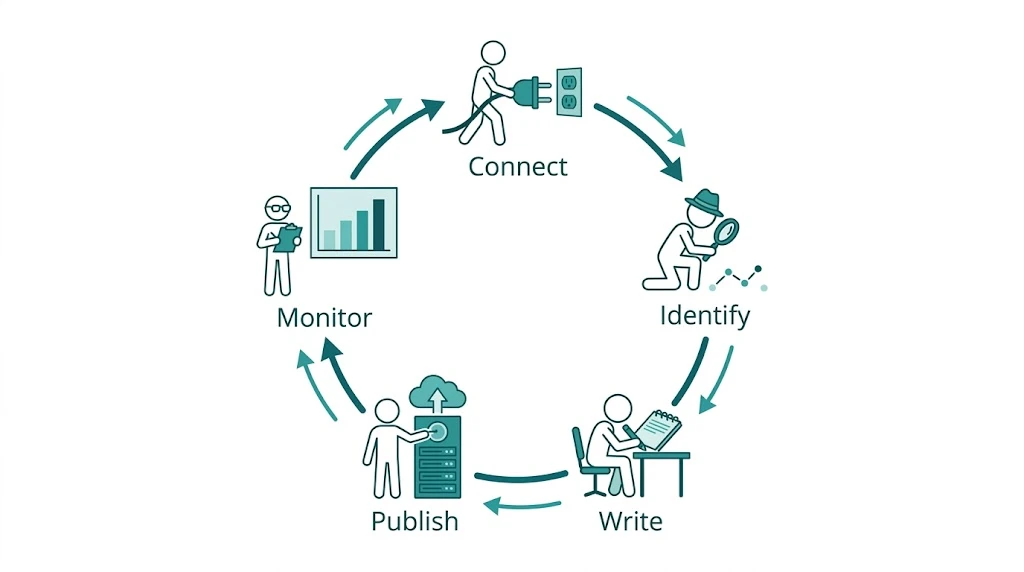
It starts with your data. When your Google Search Console is connected to an AI SEO agent, you get a real-time picture of what's ranking, what's slipping, and what's missing - without manually pulling reports. The system reads your actual performance data, not generic keyword databases.
Then it identifies your competitor gaps. Which keywords are your direct competitors ranking for that you aren't? Which questions are your potential customers typing into Google that nobody in your category is answering well? These aren't hypothetical gaps - they're real traffic opportunities with real intent behind them.
Then it writes. Not generic, recycled content. Topically relevant, structurally sound SEO content automation that matches the intent behind the keyword and the voice of your brand.
Then it publishes - directly to your CMS. No formatting. No copy-paste. No forgetting to add the meta description. That's AI content publishing as infrastructure, not another manual step.
Then it loops. Rankings move, the system adapts. You get outcomes instead of open browser tabs.
This is what Thoth AI was built to do. Not to add another tool to your SEO stack - but to replace manual execution with an AI SEO agent. If you're trying to replace SEO agency with AI, this is the model that finally makes it practical.
Agentic SEO is the positioning shift that changes everything
There's a mental model shift underneath all of this, and it's worth naming directly.
Most founders think about SEO as a channel to manage. You allocate some hours, you produce some content, you check the results.
The founders growing fastest right now think about SEO as infrastructure. It runs in the background, it compounds over time, and it doesn't require 20 hours of weekly attention to stay alive. That's AI-driven content strategy in practice, and it's how you do SEO without a content team.
That's the "AI CMO" frame. Not a replacement for human strategy - you still decide what markets you're going after, what your brand voice sounds like, what makes your product different. But the execution layer? The research, writing, publishing, monitoring cycle? That can and should be automated.
The companies that will dominate organic search in 2027 and 2028 are building this infrastructure now. They're not waiting until they can afford to hire a content team. They're automating the content function from day one, and that is the future of SEO 2026 already unfolding.
What this means for you right now
If you're doing SEO manually in 2026 - running audits yourself, writing every blog, manually tracking your rankings - you're not just working hard. You're working in a model that's already been disrupted.
The question isn't whether AI agents will take over SEO execution. They already are. The question is whether your growth competes on that playing field or falls further behind while you're still building spreadsheets.
The AI CMO model isn't coming. It's here. The startups using it aren't publishing one blog a week and hoping. They're publishing at scale, ranking faster, and spending their actual time on the strategy decisions that matter.
FAQ: AI CMO and SEO automation for startups
What is an AI CMO?
An AI CMO is an AI SEO agent that runs the full SEO execution loop for you: connect data, identify gaps, write content, publish, monitor, and improve. It's not just analysis. It's an automated SEO platform designed to produce outcomes.
How to automate SEO for startups without a content team?
Start with Google Search Console automation, competitor gap detection, and SEO content automation in one workflow. The goal is simple: move from manual SEO tasks to a repeatable SEO autopilot system that can run even when your team is small.
How much time does SEO take per week if you do it manually?
For most founders and growth marketers, manual SEO tasks take around 15-20 hours per week when you include audits, planning, writing, publishing, and monitoring. That's exactly why more teams now replace SEO agency workflows with AI-assisted execution.
Can AI tools replace an SEO agency?
In many cases, yes. The best AI tools that replace SEO agency work handle research, briefs, writing, publishing, and monitoring inside one system. You still own strategy and positioning, but the execution-heavy work becomes autonomous SEO.
If you want to see what autonomous SEO execution looks like in practice, Thoth AI connects your GSC, identifies your gaps, writes your content, and publishes - automatically. It's an AI growth marketing tool built for startups that want AI tools that replace SEO agency busywork. No 20-hour weeks required.