
Steal Your Competitors' SEO Gaps Automatically
Your competitors are ranking for keywords you don't even have a page for yet. Here's exactly how to find those gaps using GSC data - and close them automatically before they widen further.
On this page
Table of contents
Steal Your Competitors' SEO Gaps Automatically
Your competitor is ranking on page one for a keyword your ideal customer searches every day. You have no page for it. You didn't even know the keyword existed.
That's not a keyword research failure. That's a competitor intelligence failure - and it's costing you traffic that should already be yours.
Most founders and growth marketers run keyword research the wrong way. They start from scratch: brainstorm topics, check volume, assess difficulty, write content. That process finds keywords. It doesn't find the specific gaps where your competitors are already winning traffic you could be capturing.
This post is about the second approach. How to systematically find keywords competitors rank for, which ones are worth going after, and how to close those gaps automatically instead of adding them to a spreadsheet that never gets actioned. If your goal is SEO gap analysis for SaaS, this is the practical workflow.
Why your GSC data is hiding your biggest GSC keyword opportunities
Most people open Google Search Console to check traffic drops or monitor overall performance. That's the wrong frame.
GSC is your most accurate source of competitor intelligence you're not using, and it's often the fastest way to understand why competitors outrank me on Google for terms I should own.
Here's the specific signal most teams miss: queries where you're getting impressions in positions 11-30 but have no dedicated page are opportunities to create targeted content for queries you're already on the edge of ranking for.
These aren't hypothetical gaps. These are keywords Google has already decided your site is relevant for - just not relevant enough because you haven't built the right page yet. You're getting the impression, missing the click, and leaving the traffic for whoever built a better page.
There's often a disconnect between what a webpage says it's about and what its audience is actually searching for. The stakes are higher now - if your page fails to match user intent, it won't show up in AI-powered search surfaces.
The fix isn't to write more content. It's to write the right content - specifically the pages that close the gap between where you're showing up and where you're actually ranking.
The difference between keyword research and competitor gap analysis
Keyword research tells you what people search for. Competitor gap analysis tells you what people search for that your competitors are capturing and you're not.
That distinction changes everything about how you prioritize content.
Keyword gap analysis finds specific queries competitors rank for that you don't. Content gap analysis finds structural holes in your topical authority. The most actionable gaps sit at the intersection of both - where a competitor ranks for a keyword that fits your subject area, has real search demand, and you have no dedicated page.
A raw keyword research list gives you 500 potential topics sorted by volume. A competitor gap analysis gives you 20 specific opportunities where a competitor is actively taking traffic that could be yours - ranked by how fast you can realistically close the gap.
For an early-stage SaaS team with limited content bandwidth, that focus is the difference between a content strategy that compounds and one that spins.
How to use GSC for competitor analysis and find keyword gaps
Here's the process that actually works - no third-party tool required to start. It's the same core method behind most competitor keyword gap tool workflows, just done directly from your own data.
Step 1: Identify your real SEO competitors
Your business competitors and your SEO competitors are not the same. The biggest first mistake in competitor content analysis is choosing the wrong competitors - the agency you compete against for clients may not be ranking for the keywords your audience is searching for.
Find your real SEO competitors by searching 5-10 of your target keywords and noting which domains appear consistently in the top 10. Those are your actual competitors for this exercise, not the brands you pitch against in sales calls. This step alone improves how to outrank competitors in Google because it fixes bad target selection early.
Step 2: Pull your GSC query data
Export your full query report from GSC - all queries, all positions, last 12 months. Filter for:
- Impressions over 100
- Average position between 8 and 30
- Click-through rate under 3%
High impressions with low CTR signals a snippet mismatch, intent mismatch, or weak title and meta. Positions 8-20 mean you're close - content depth or relevance is likely the issue.
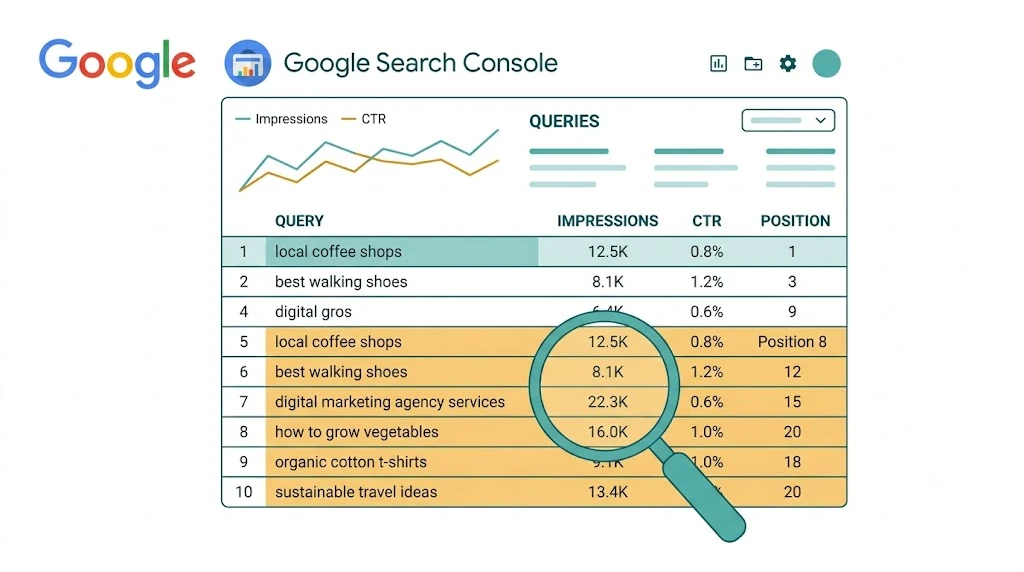
These are your near-win keywords and near-win gaps. Google already associates your site with these queries. You need a dedicated, better-optimized page to move from invisible to ranking.
Step 3: Cross-reference against competitor pages
For each near-win keyword, check whether your top SEO competitor has a dedicated page for it. If they do and you don't - that's a confirmed gap with proven demand. Someone built a page for this keyword because it converts. You don't need to validate the opportunity; they already did.
Step 4: Layer in "dark gap" keywords
These are the most valuable gaps - keywords your competitor ranks for that you don't appear for at all. No impressions, no position, no page. A raw list of missing keywords isn't a strategy - the commercially relevant gaps like product categories and buying guides come first, not utility content that builds authority but doesn't convert.
Sort your gap list by intent. Problem-aware keywords ("why is my SaaS not ranking") and solution-aware keywords ("competitor SEO gap tool") convert. Purely informational keywords build authority but rarely drive signups directly. Prioritize the former.
How to prioritize keyword gaps and close them first
The most valuable gaps are ones that fit into content clusters you're already building. A gap that fills a missing piece in your existing cluster is worth more than an isolated opportunity in an unrelated topic. This is how you close topical authority gaps instead of publishing disconnected articles.
Beyond cluster fit, filter by three criteria:
Keyword difficulty vs. your current authority. Focus on gaps in the KD 20-40 range first - these are often your low competition keywords 2026 opportunities where you can actually move rankings within 3-6 months rather than chasing KD 80 keywords that require domain authority you don't have yet.
Search intent alignment. In 2026, Google's algorithms are increasingly sophisticated at identifying micro-intents. If the top results for a keyword are all independent review listicles and you publish a product landing page, you will likely never break the top 5 regardless of keyword density or backlink profile. Match the format your competitors are winning with, then beat them on depth and utility.
SERP feature opportunity. Most SEOs look at the blue links and ignore the SERP features - Knowledge Panels, Featured Snippets, People Also Ask boxes, and AI Overviews. In 2026, these features capture up to 60% of visual real estate above the fold. A competitor ranking #1 for a definition query is holding a Featured Snippet. You beat them by providing a more precise, data-backed answer in the 40-60 word range Google's parser prefers. This is SERP gap analysis in practice.
The execution problem nobody talks about
Here's where most competitor gap analyses die.
You do the research. You export the data. You build the spreadsheet. You have 40 confirmed gaps, prioritized, with keyword difficulty scores and intent labels and a content brief for each one.
Then the execution falls back on the same bottleneck it always does: someone has to write 40 pieces of content, optimize them, and publish them. At one blog a week, you're closing gaps for the next 10 months while your competitor keeps publishing.
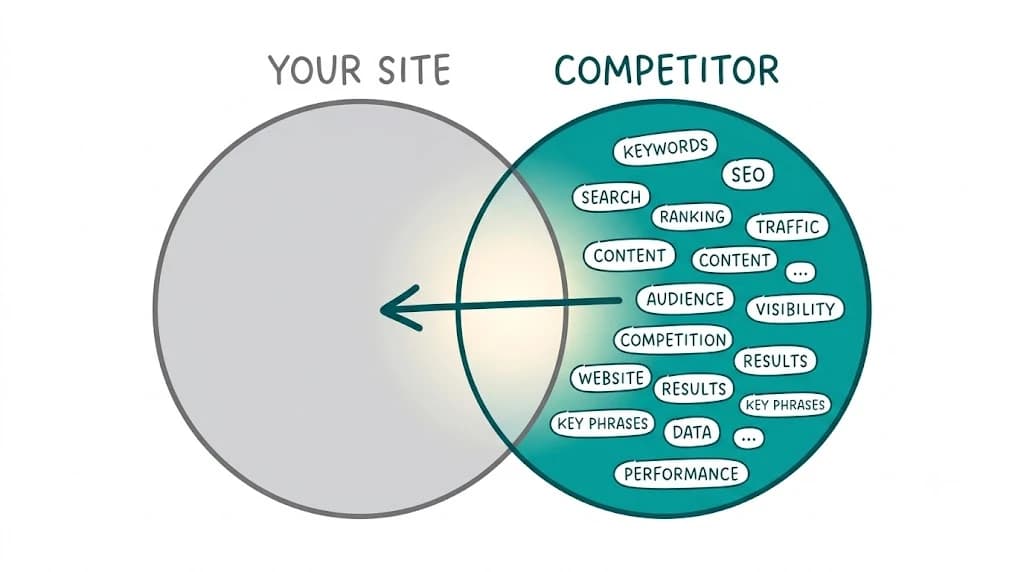
The Venn diagram of shared keywords, unique competitor keywords, and untapped opportunities can cut competitive analysis time from 2 hours to 20 minutes per competitor. But analysis speed isn't the bottleneck. Execution speed is.
Agents help you operationalize gaps - connecting GSC data, inventory, SERP patterns, prioritization, and briefing into one repeatable workflow. That's the shift from competitor intelligence as a monthly report to competitor intelligence as a continuous execution loop. Ubersuggest
This is exactly what Thoth AI CMO is built around. Your GSC connects, the gaps surface automatically, content gets written against each gap, and publishes to your CMS - without the 40-item backlog sitting in a spreadsheet waiting for bandwidth you don't have.
The "steal the snippet" tactic most teams skip
One specific gap type worth calling out separately because it's fast to execute and consistently undervalued.
When a competitor holds a Featured Snippet for a keyword in your category - a definition, a how-to, a comparison - they own the zero-click answer for that query. Every time someone searches it, your competitor's brand gets the association.
If a competitor holds a Featured Snippet for a definition query, you beat them by providing a more precise, data-backed answer in the 40-60 word range that Google's parser prefers. This featured snippet steal play is also a strong zero-click SEO strategy because it wins visibility before the click.
The process:
- Search your 20 highest-priority gap keywords manually
- Note which ones have Featured Snippets owned by a competitor
- On your new page for that keyword, write a clean 40-60 word definition block immediately after the H2
- Add FAQPage schema to make the Q&A machine-readable
Within 90 days of closing prioritized gaps with dedicated pages, teams have seen 27 target terms reach page one and organic leads approximately triple as comparison pages begin ranking. The snippet steal is the fastest path to visible results because you're not building authority from scratch - you're targeting a specific format Google has already decided works for that query.
What automated competitor gap analysis looks like end-to-end
The manual version of this process - pulling GSC data, cross-referencing competitors, scoring gaps, briefing content, publishing - takes roughly 6-8 hours per cycle. Most teams run it quarterly at best, which means the gap list is always 3 months stale.
The automated version runs continuously:
GSC data flows in -> gaps are identified against competitor rankings -> content is prioritized by intent and difficulty -> briefs are generated -> content is written and published -> new rankings feed back into the loop.
A good AI agent doesn't rely on one dataset. It triangulates - GSC as the truth source for what Google already associates with your site, competitor keyword overlap tools for what other sites cover that you don't, and SERP pattern analysis to validate intent before a single word gets written. That's the core of AI competitor SEO intelligence and continuous SEO gap monitoring.
The output isn't a report. It's a closed gap. A published page. A keyword moving from position 14 to position 3. That's what GSC gap automation should deliver.
That's the difference between competitor intelligence as analysis and competitor intelligence as execution.
The fastest way to close competitor gaps isn't a better spreadsheet - it's a system that finds them, writes the content, and publishes automatically. That's what Thoth AI CMO does.
FAQ
What is competitor SEO gap analysis?
Competitor SEO gap analysis is the process of identifying keywords your competitors rank for that your site doesn't - and using that data to prioritize content that closes the gap and captures traffic you're currently missing.
How do I find competitor keyword gaps without paid tools?
Export your Google Search Console query data and filter for queries with high impressions but positions 8-30 and low CTR. These are keywords Google already associates with your site where a dedicated, better-optimized page would move you into ranking position. Cross-reference them against competitor pages manually to confirm which gaps have proven demand.
How to find keywords competitors rank for but you don't?
Start with your real SEO competitors, export your GSC query data, and build a list of near-win keywords where you are in positions 8-30. Then manually check competitor pages for each term and add dark-gap terms where competitors rank but you have zero impressions. This is the fastest way to find keywords competitors rank for with proven demand.
What is a keyword gap in SEO?
A keyword gap in SEO is a query where a competitor has ranking visibility and your site does not. Content gap vs keyword gap is the key distinction: keyword gaps are missing query-level opportunities, while content gaps are broader topical authority gaps.
How many competitor keywords should I target at once?
Start with 5-10 high-priority gaps that sit in content clusters you're already building, have keyword difficulty under 40, and match commercial or problem-aware intent. This is especially effective for keyword gap SaaS teams with limited bandwidth. Closing 10 gaps with strong pages beats creating 40 thin pages every time.
How long does it take to rank after closing a gap?
With a focused approach - prioritized gaps, dedicated pages, proper internal linking - teams have seen 27 target terms reach page one within 90 days. Near-win keywords (positions 8-20) move fastest because Google already associates your site with them. PromptDrive
How to close SEO content gaps fast?
Prioritize commercially relevant gaps first, match search intent format, publish dedicated pages instead of broad catch-all posts, and run a weekly refresh loop from GSC data. Automated competitor gap analysis helps close SEO content gaps fast by removing manual bottlenecks between analysis and publishing.
How to prioritize keyword gaps?
Prioritize by cluster fit, intent value, and difficulty range, then validate SERP feature opportunity before writing. In practice, this means choosing pages most likely to improve rankings quickly and support how to outrank competitors in Google.
What's the difference between a content gap and a keyword gap?
Keyword gap analysis finds specific queries competitors rank for that you don't. Content gap analysis finds structural holes in your topical authority - subjects that belong in your coverage model but are absent or incomplete. Both matter. Keyword gaps give you quick wins; content gaps give you long-term topical authority.
Can AI automate competitor SEO gap analysis end-to-end?
Yes. An AI SEO system can connect to your GSC data, identify near-win and dark-gap keywords automatically, cross-reference competitor rankings, prioritize gaps by intent and difficulty, and publish content to close them - without manual exports or spreadsheets. Thoth AI CMO does exactly this: continuous competitor gap monitoring feeding directly into automated content execution, so gaps get closed as they are found rather than sitting in a backlog.